

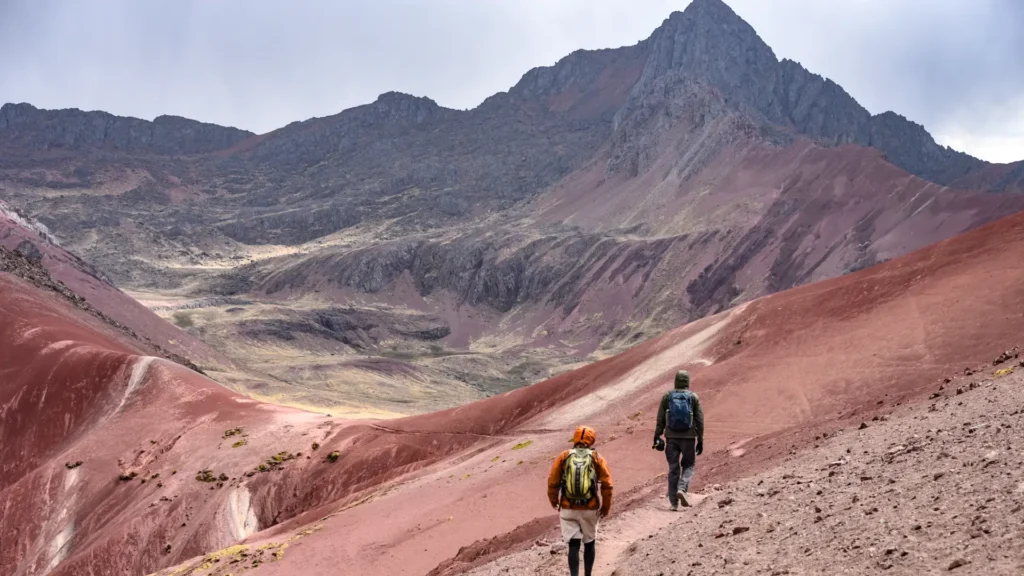
If you search for images of Cusco on the internet, you are almost guaranteed to encounter a hypnotic postcard: a mountain peak striped with vibrant colors that looks like it was pulled from a dream. Vinicunca, known globally as Rainbow Mountain, has rapidly become the second most visited destination in Peru. For many travelers, the choice of Vinicunca vs Palcoyo is the first step in planning an unforgettable Andean adventure.
However, for us at Machupicchu Mountain Tours, these mountains are not just isolated geological anomalies or mere backdrops for social media photos. They are the most famous manifestations of a much broader ecosystem located in the Vilcanota Mountain Range, which also includes sister formations like the surreal Red Valley. This region holds the secrets of millions of years of history, hidden beneath the ice until very recently.
In this article, we will unravel the shared history of these landscapes: from deep planetary processes and the impact of climate change to profound Andean spiritual heritage. We invite you to explore the modern conservation challenges we face as responsible travelers and discover which of these peaks resonates most with your spirit. Whether you prefer a challenging trek or a contemplative walk, the colored mountains of Peru offer a transformative experience.

The Mineral Archive: A Shared Geological Origin
Many travelers wonder if the colors of Vinicunca and Palcoyo were recently “painted” or if they are some kind of optical illusion. Science provides a much more fascinating answer: these mountains are a canvas that took millions of years to finish. The formative process began between the Cretaceous and Miocene periods, when what we see today at over 5,000 meters was once the bottom of primitive lakes and seas.
Over geological eras, thick layers of marine and fluvial sediments accumulated. With the violent collision of tectonic plates and the subsequent uplifting of the Andes, these subterranean layers were pushed to the surface, folding and fracturing in the process. This Vinicunca vs Palcoyo comparison starts with a shared birth from the earth’s crust, exhuming complex stratigraphic sequences that were once hidden miles underground.
The magic of color happened when these minerals were finally exposed to oxygen and Andean humidity, triggering a spectacular oxidation process. Red and pink originate from iron oxide (hematite), while greens are created by phyllites rich in magnesium. These distinctive colorations of the Marcapata Formation serve as an open textbook on the differential oxidation of minerals exposed to extreme weathering over millennia.
Glacial Retreat and the Modern “Discovery”
There is a crucial and bittersweet detail in the history of the colored mountains: they were always there, but they remained hidden under thick layers of perpetual snow. Unlike Machu Picchu, which was introduced to the outside world in 1911, Vinicunca was a recent “discovery” triggered directly by global warming. As global temperatures rose, the glaciers of the Vilcanota Range began to melt, revealing the stripes that had been protected for ages.
Around 2015, the first alpaca herders and intrepid trekkers circling the snowy Ausangate took photographs that exploded virally. In just a couple of years, the debate of Vinicunca vs Palcoyo became a central topic for tourism in southern Peru. This rapid transition from an unknown wasteland to a world-famous destination forever altered the dynamics of the local communities and the surrounding high-altitude environment.
While the beauty revealed is breathtaking, it serves as a stark reminder of our changing climate. The retreat of the glaciers has opened a new chapter for tourism, but it also highlights the vulnerability of the Andean peaks. At Machupicchu Mountain Tours, we see these mountains as a testament to nature’s resilience and a call to action for every traveler who walks upon their fragile, multicolored soils.

Vinicunca vs Palcoyo: Diversifying the Experience
The explosive boom of Vinicunca generated a problem of tourist saturation, leading to the promotion of Palcoyo as a sustainable alternative. Comparing both destinations is essential so you can choose the adventure that best suits your physical condition and expectations. While Vinicunca rises to a demanding 5,200 m.a.s.l. and requires a strenuous hike, Palcoyo offers a much more accessible route at 4,900 m.a.s.l. with mostly flat terrain.
Visually, the Vinicunca vs Palcoyo experience offers different rewards. Vinicunca stands out for the intense contrast of colors concentrated on a single monumental peak and the option to visit the nearby Red Valley. Palcoyo, on the other hand, offers a panoramic view where you can see up to three multicolored mountains simultaneously. It is often flanked by an intriguing “stone forest” and provides clear, direct views of the sacred Ausangate glacier.
The weather factor is also vital, as the colors are alive and change according to the season. During the dry season, the lack of humidity makes the minerals look highly saturated under the bright Andean sun. During the rainy season, the colors may darken or be covered by a sudden blanket of snow, turning the landscape into a white wonderland. Each mountain offers a unique aesthetic that changes with the rhythm of the mountain air.
The Sacred Apus: Meaning in the Andean Cosmovision
For the local Quechua-speaking communities, these mountains were never simple geological accidents; they are Apus, or protective spirits. In Andean cosmology, the spectacular color palette of the mountains has deep spiritual symbolism. Red represents the Pachamama (Mother Earth) and the blood of life, while white symbolizes the snowy peaks and the purity of life-giving water that flows from the glaciers.
In the context of Vinicunca vs Palcoyo, both ranges are seen as younger siblings to the Major Apu: the imposing Ausangate snow peak. Green represents the promise of agricultural fertility and lush pastures for the alpacas, while yellow represents vital energy and the sun (Inti). Even today, local communities continue to make “pagos a la tierra” (offerings) to ask for protection for their flocks and good harvests.
As scholars have noted, the sacredness of the Andean landscape lies in the reciprocal relationship, or Ayni, between humans and the mountains. Altering this landscape without due ritual respect is considered a rupture of the cosmic order. By visiting these peaks, travelers are not just seeing a sight; they are entering a sacred space where the connection between the people and the earth remains a living, breathing tradition.
Extreme Fragility: The Conservation Challenge
Belonging to the high Andean tundra, all the colored mountains face severe threats due to their extreme altitude and lack of deep-rooted vegetation. This means the ancient layers of mineral sediments are extremely vulnerable to erosion. While freezing winds and temperature changes take a natural toll, the biggest modern threat to the Vinicunca vs Palcoyo ecosystems is the impact of human footsteps.
Every footprint off the marked trails destroys a sediment that took millions of years to solidify. If tourists ignore signs in search of “the perfect photo,” they drastically accelerate the degradation of this unrepeatable geological archive. The soil above 5,000 meters is incredibly thin and fragile, meaning that damage done today can take centuries to recover, if it recovers at all.
Making responsible tourism management a priority is not an option; it is a critical challenge for the survival of these colorful ecosystems. At Machupicchu Mountain Tours, we guarantee small groups and absolute respect for the marked trails. Our guides are trained to teach you how to honor the mountain just as the Incas did, ensuring that these rainbows of stone remain for generations to come.

Conclusion: Travel with Conscience
Visiting Vinicunca or Palcoyo is one of the greatest privileges a traveler can have in modern Peru. However, this privilege comes with an enormous responsibility to the land and the people who call it home. Choosing between Vinicunca vs Palcoyo is about more than just the hike; it is about choosing how you want to interact with one of the most unique landscapes on Earth.
At Machupicchu Mountain Tours, we believe that the best way to experience these wonders is through education and respect. By choosing our guided expeditions, you support local communities and conservation efforts that keep these mountains vibrant. We invite you to be a part of a travel culture that values the preservation of natural history as much as the adventure itself.
Are you ready to walk above the rainbow of the Andes and discover the secrets of the Vilcanota Range? Contact us today to decide which colored mountain will conquer your heart and start your journey into the sacred history of the Incas. Book your experience here and prepare for a transformation that only the high Andes can provide.
