For decades, the Cusco region was almost exclusively synonymous with classic archaeological tourism. Travelers from all over the world arrived with a single goal in mind: to explore the wonders of the Sacred Valley and marvel at the majesty of Machu Picchu. However, the contemporary traveler has evolved.
Today, the capital of the Inca empire is experiencing a revolution towards nature, adventure, and high-mountain tourism, deeply influenced by the mysticism of the Andean worldview. At the epicenter of this new golden age of trekking lies a destination that takes your breath away (literally and figuratively): Laguna Humantay (Humantay Lake).
At Machupicchu Mountain Tours, we have prepared this comprehensive and scientifically-backed guide so you can understand why this turquoise lake is much more than just a photo for your social media.

Sacred Geography and the Eternal Bond with the Apus
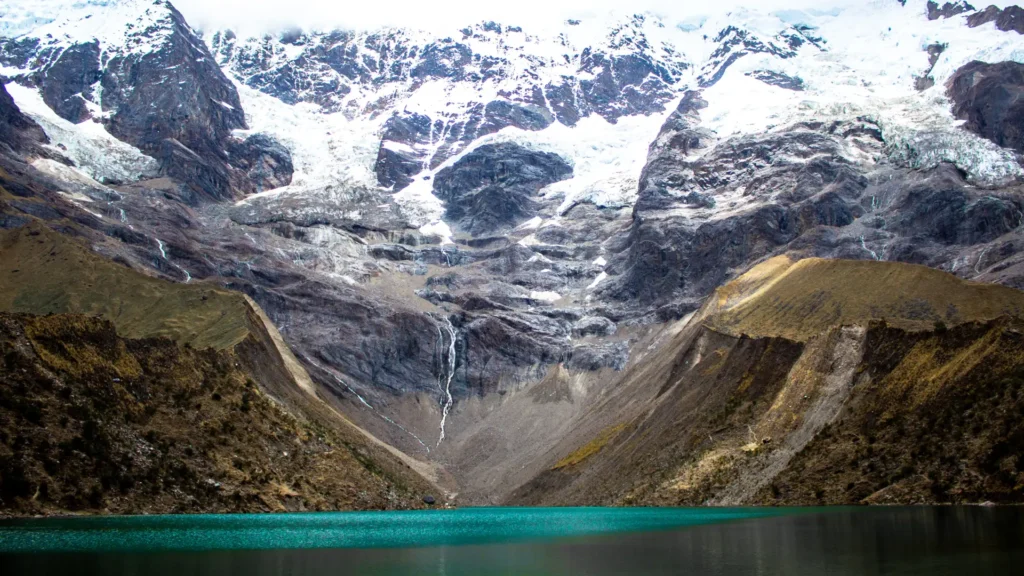
To understand the magnitude of Laguna Humantay, we must first understand where we are standing. The lake is located at an imposing altitude of 4,270 m.a.s.l. (14,009 ft), resting directly at the foot of the snow-capped Humantay mountain, an ice colossus that rises to 5,473 m.a.s.l. (17,956 ft).
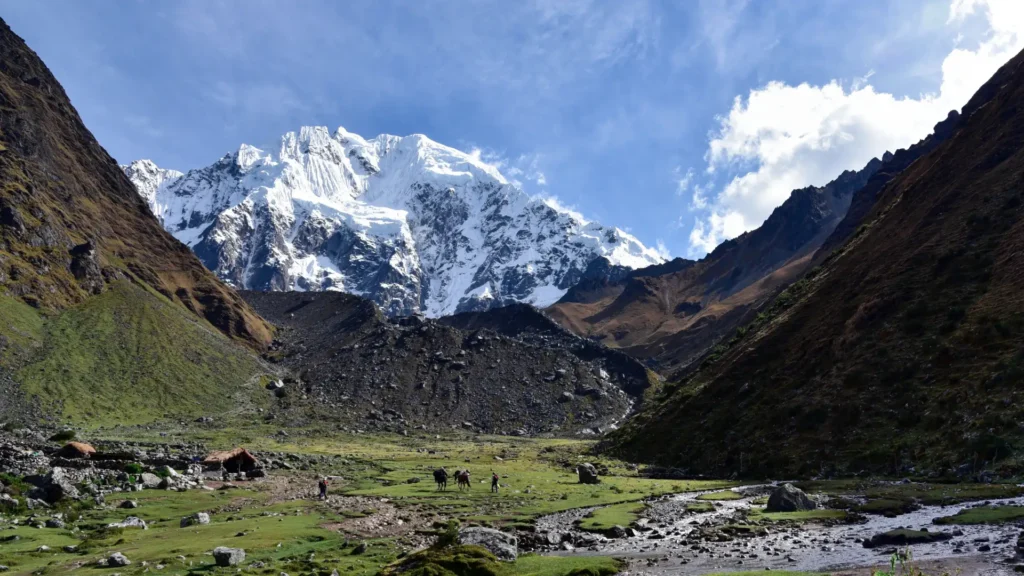
But this glacial body of water is not isolated; it is part of the basin and the immediate surroundings of the majestic Apu Salkantay (known as the “savage mountain”). In the Andean worldview, an “Apu” is not just a geographical feature; it is a tutelary spirit, a mountain god who protects the communities, controls the weather, and fertilizes the land through the water from its melting glaciers.
Just as with the Rainbow Mountain (Vinicunca) or the imposing Ausangate, visiting Laguna Humantay allows our travelers to enter a living, sacred landscape. Those who undertake multi-day expeditions with us have the privilege of sleeping in camps under starry skies, where the dawn bathes these protective mountains in gold.
“In the Andes, geography is sacred. Mountains are not simply climbed to be conquered; they are pilgrimage sites where one asks for permission and pays homage. The water descending from the glaciers is considered the blood of the earth (Yaku), uniting the celestial world with the earthly realm.”
Recommended research source: Journal of Anthropological Archaeology – Sacred Landscapes of the Andes.
The Mystery Under the Ice: Underwater Archaeological Research
In the pre-Hispanic Andean world, glacial lakes located near major Apus were considered huacas (deeply sacred spaces). Historically, in lakes such as Titicaca, offerings of gold, silver, and Spondylus shells have been found submerged as tributes to the water gods.
Based on this archaeological premise, did Laguna Humantay hide Inca treasures beneath its turquoise waters?
Between 2016 and 2017, a team of researchers decided to solve this mystery. They carried out rigorous underwater archaeological surveys using state-of-the-art hydroacoustic technology (sonars) and a team of specialized high-mountain divers.
The Scientific Discoveries:
- Bottom Topography: The lake bed was mapped, revealing a funnel-shaped geological profile.
- Depth and Climate: It reaches a maximum depth of 20 meters and maintains a freezing average temperature of 8°C (46.4°F).
- The Verdict: Unlike other Andean bodies of water, no material evidence of pre-Columbian offerings or submerged human activity was found.
The lithic elements detected at the bottom turned out to be basalt rocks, corresponding to natural geological deposits caused by ancient avalanches and the constant melting process. This suggests that Laguna Humantay inspired such respect (and possessed such an extreme climate) that it was venerated from a distance, kept intact and pure.
The Trekking Boom and Tourism Decentralization in Cusco
Within the contemporary tourism market, Laguna Humantay plays a vital logistical and commercial role: it is helping to decongest traditional archaeological routes. At Machupicchu Mountain Tours, we offer the two most spectacular ways to live this experience:
The Famous Salkantay Trek (2 to 5 days)
The lake is the scenic crown jewel during the first stretch of the Salkantay Trek. This hike has definitively consolidated itself as the most popular and impressive alternative route to the saturated Classic Inca Trail. By choosing this option, the traveler experiences total immersion: transitioning from the freezing high Andean tundra, passing the foot of the glacier, to descending vertiginously into the warm, humid cloud forest surrounding Machu Picchu.
The “Full Day” Excursion
Following the same commercial model that catapulted Rainbow Mountain to fame, Laguna Humantay has become the most demanded full-day tour from the city of Cusco. It is an intense adventure that starts at dawn, demands a steep ascent of approximately one and a half to two hours, and rewards with incomparable photographic views before returning to the city by dinnertime.
Physical Capacity, Acclimatization, and Altitude Sickness Prevention
Do not be fooled by the beautiful photos on Instagram; reaching Laguna Humantay requires physical effort. The final ascent is steep and, most importantly, takes place above 4,200 meters of altitude. At this height, the oxygen level is significantly lower than at sea level.
For this reason, at our agency, we are emphatic about the safety of our passengers. We do not recommend doing this tour on the same day you arrive in Cusco.
“Rapid ascent to altitudes above 4,000 meters without proper prior acclimatization is the main risk factor for developing Acute Mountain Sickness (Soroche). A staged acclimatization of at least 48 to 72 hours at intermediate altitudes is strongly recommended.”
Recommended research source: High Altitude Medicine & Biology – Altitude Sickness Prevention.
Our Golden Recommendations for Trekking:
- Smart Acclimatization: Do this tour after having spent at least two days in Cusco or the Sacred Valley, or even after having visited Machu Picchu (which is located at a much lower altitude, 2,400 m.a.s.l.).
- Steady Pace, Not a Race: Walk at your own pace. In the mountains, the tortoise always beats the hare.
- Hydration and Energy: Take small sips of water constantly and bring carbohydrate-rich snacks, along with coca leaves or lemon candies.
Conclusion: The Triumph of High-Altitude Landscape Tourism
When analyzing the general panorama of tourism in Cusco, Laguna Humantay represents the ultimate peak of landscape and adventure tourism.
Although recent archaeological surveys have ruled out that its depths were a center for Inca underwater sacrifices or tributes, its impressive visual beauty, its glacial origin, and its proximity to the sacred spirit of the Apu Salkantay have rapidly positioned it as a must-see destination.
It is the perfect place for modern travelers looking to combine the physical challenge of trekking with the unbreakable purity of the Andes geography. Are you ready to conquer the mountain? Let Machupicchu Mountain Tours guide you every step of the way.