You have traveled across the world to stand before the greatest architectural achievements of the Inca Empire, booking five-star hotels and arranging private dinners. However, a silent anxiety likely lingers as you prepare to ascend above the city of Cusco. The immediate threat of altitude sickness, crushing headaches, and physical exhaustion can quickly ruin your luxury vacation.
Imagine spending your highly anticipated morning stuck in your hotel bed, gasping for breath, while standard tour buses crowd the narrow streets. Picture yourself struggling to climb steep, dusty trails to reach the ruins, forced to turn back early because your tour company does not carry medical oxygen.
You do not have to risk your health, physical comfort, or peace of mind to experience the megalithic wonders of the Andes. Discovering this imperial temple can be a relaxing, deeply enriching, and physically effortless experience when supported by medical-grade logistics. At Machu Picchu Mountain Tours, we pair university-educated historians with premium, oxygen-assisted Mercedes-Benz private transits, ensuring you explore the historic complexes at your own pace.
Reconstructing the Temple: What Did Sacsayhuaman Look Like?
To understand the historical importance of this archaeological site, you must look past the modern ruins. Many travelers view the grass-covered terraces today and assume they are looking at a simple military fort. In reality, the original design of this complex was a masterpiece of religious, administrative, and astronomical architecture.
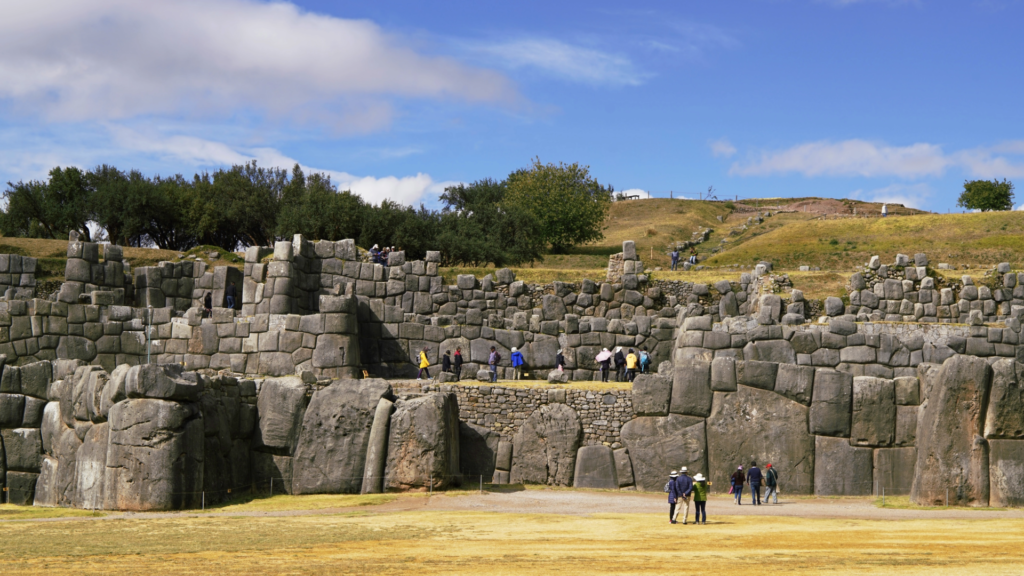
The classic historic structure of the complex was vastly different from the stone foundations visible to modern visitors. Historically, this site served as the crowning jewel of the imperial capital of Cusco, which was designed in the physical shape of a sacred puma. The zigzagging stone walls represented the powerful teeth of the predatory cat, guarding the sacred plaza below.
Architectural Reconstruction of the Sacsayhuaman Citadel
Historical excavations and early Spanish chronicles confirm that the original complex was a fully functioning citadel. The main walls were topped with three massive stone towers: Muyucmarca, Paucarmarca, and Sullumarca. These structures housed storehouses (qollqas), residential quarters for elite priests, and complex subterranean water channels. The entire upper plateau was paved with smooth, dark andesite stones, creating a polished terrace that reflected the intense Andean sun. The walls themselves were not rough military defenses; instead, they were covered in decorative sheets of hammered gold and silver that gleamed across the valley to display the wealth of the Sun King.
To help you visualize this architectural scale, our private guides carry detailed historical models and three-dimensional digital reconstructions during your tour. This sensory experience allows you to compare the current stone blocks with the historic towers that once dominated the skyline. For more on the architectural history of the Cusco valley, you can visit The Official Cusco Archaeological Registry.
Historical Destruction and the Legacy of Survival
Following the Spanish invasion in the sixteenth century, the conquering forces began a systematic campaign of destruction. Because the stone masonry was incredibly precise, the Spaniards used the complex as a quarry to build their colonial churches and mansions in the valley below. Consequently, they dismantled the upper towers, took down the administrative buildings, and removed the smaller structural stones.
“When we ask what did Sacsayhuaman look like, we must realize that over eighty percent of its original structure was carted away by colonial builders. What survives today are the megalithic foundation stones—blocks so massive that human hands could not easily move them. They remain as silent, indestructible witnesses to an empire that valued permanence above all else.” — Senior Historical Advisor at Machu Picchu Mountain Tours.
Therefore, the surviving stones represent only the heavy structural foundations of a lost imperial palace. By exploring the site with an expert historian, you learn to identify where these grand towers once stood, reconstructing the past in your mind without having to climb steep, exhausting trails.
Sacred Engineering: The Megalithic Triple Walls
The three zigzagging walls of Sacsayhuaman represent some of the most complex engineering in the pre-Columbian Americas. These stone barriers were not built merely for military defense. Instead, they formed a highly sacred sanctuary dedicated to lightning, celestial deities, and agricultural fertility.
Each level of the terrace system was constructed using massive limestone blocks, some weighing over one hundred tons. The master masons carved each block to fit flush against its neighbor without any mortar. Consequently, the walls could withstand the strongest earthquakes that regularly shook the valley of Cusco.
[IMAGEN – Archivo: “sacsayhuaman-triple-walls-masonry.jpg” | ALT: “A close-up of the massive stone masonry of Sacsayhuaman showing the dry-stone puzzle fit”]
The layout of the terraces was meticulously aligned with astronomical events, such as the winter and summer solstices. During the morning of the solstice, the rising sun cast specific shadows across the zigzag angles. Therefore, the complex functioned as a massive solar calendar for the agricultural year. You can read more about how these alignments influenced Inca agricultural cycles.
Seamless Exploration: VIP Access vs. Crowded Buses
Reaching the top of the archaeological complex can be physically punishing if you choose standard transportation. Mass-market tour groups typically park their large buses at the lower city lots, forcing guests to climb a steep, dusty trail in the thin mountain air. Consequently, many travelers arrive at the summit gasping for air and suffering from severe physical fatigue.
Alternatively, our private Mercedes-Benz Sprinters utilize exclusive access points to bypass this exhausting climb entirely. Our professional driver drops you off directly at the flat, grassy plateau on the upper level of the ruins. Therefore, you save your energy for the historical exploration rather than wasting it on steep access hills.
The upper plateau of the complex sits at approximately 12,139 feet (3,700 meters). This altitude increase can cause a sudden drop in your blood oxygen levels ($SpO_2$). To prevent dizziness and headaches, our private transport is equipped with professional medical-grade oxygen concentrators. If you are planning your trip, view our Private Cusco Heritage Itineraries to see how we prioritize your health.
Comparative Data: Your Safety and Comfort
Choosing the correct logistical framework is critical. To help you visualize the differences between standard mass tourism and our elite safety-first model, we have created this comparison table.
| Comfort Feature | Standard Mass-Market Tour | Machu Picchu Mountain Tours |
| Arrival Route | Steep 30-min uphill hike | VIP drop-off on flat plateau |
| Oxygen Safety | None (No medical support) | $SpO_2$ monitoring & O2 tanks |
| Itinerary Pace | Rigid group schedule | Fully customized & slow-paced |
| Vehicle Type | Noisy, crowded commercial bus | Premium Mercedes-Benz Sprinter |
| Guide Expertise | General megaphone speeches | Private local historian |